Building Fly Tying Inventory with AI coding tools
I have a Ph.D. in computer science, I love data, and I'm a little overly organized. I also tie flies.
Fly Tying Inventory is where those interests meet. It is a free web app and iPhone app for fly tyers. The practical goal is simple: help a few other tyers avoid buying materials they already own. I build it on my own, working with AI coding tools.
What it does
The app answers three questions at the bench. What do I have? What can I tie? What do I need?
You track materials by category, color, size, quantity and storage location. A matching engine compares that inventory with the pattern library. It shows what you can tie and suggests substitutions. You can add anything missing to a shopping list linked to the pattern.
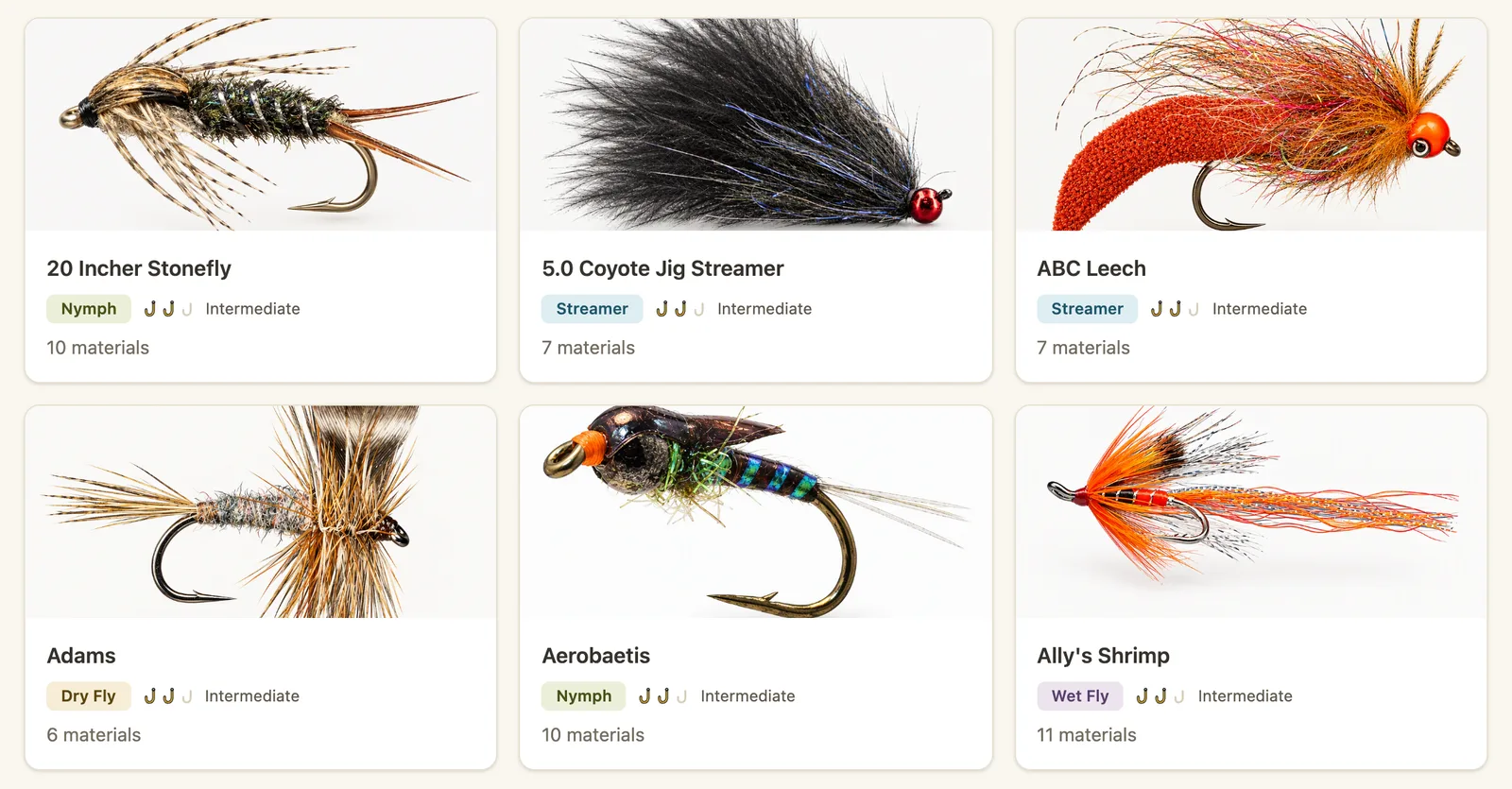
As I write this, the library has 682 patterns, 5,250 catalog materials and 264 suggested substitutions. You can also save your own patterns, share them by link, or submit them to the community library.
Entering materials is tedious, so there are shortcuts. The camera scans UPC barcodes, and each scan improves future lookups. Photo Identify, a beta, reads a photo of materials on your bench and matches them to the catalog. A newer beta, Identify a fly, takes a photo of a fly and suggests up to three library patterns.
How it's built
The first commit, on March 17, 2026, came straight out of Create Next App. There are 608 commits now.
It is Next.js 16, React 19 and TypeScript. Data lives in PostgreSQL on Supabase, through Prisma. It deploys on Vercel. Merging to main is deploying, so every check on a pull request has to be green first.
CI replays every database migration into an empty database and compares the result with the schema. That gate exists because it did not. Eight tables and roughly thirty columns had drifted out of the migration history. Nothing ran the replay, so nothing noticed.
The iPhone app is a thin Capacitor shell. It loads the live website in a web view, with native Apple sign-in and deep links on top. CI never builds iOS; the web and iOS pipelines are split on purpose. An Android shell exists too, but it is paused. New personal Google Play accounts must verify a real Android phone, and I have an iPhone.
The photo features run on OpenAI models through Azure. Identify a fly is a hybrid. A small image model inside the serverless function shortlists eight candidate patterns. Then one language model call sees the photo, those eight reference images and the whole catalog as text. The image model is rebuilt weekly when the library changes, and a benchmark is scheduled monthly. Its test set is 200 shop and web photos. When the fly was in the library, the recorded run named it first 87.4% of the time.
How I work with AI
Many of the early commits list GitHub Copilot as co-author. Since September, nearly every commit lists Claude Opus or Claude Fable.
My main habit is review before code. For anything non-trivial, the plan lands in the repo first as a design doc, in a pull request with no code. Another model critiques it before anything gets built. The first one was the proposal for the site's About page. I also ask Fable to review plans inside a session. Fable audited the Identify a fly plan, then verified the build before release.
Parallel agents earn their keep on pattern research. The library sat at 316 patterns from March until October. Now agents research batches of about 25 flies from public tutorials, recipe pages and video frames. A separate reviewer checks each batch. Nothing new is visible to anyone until I approve it in the admin review queue.
An audit of one big tutorial site found 285 flies the library lacked. Claude recommended against building all of them. I said to do all of them, and it did.
Some things stay with me. Claude drafts replies to feedback, but I send them. My words were "Don't send the draft replies. I will do that myself." Production database changes wait for my go-ahead.
Claude also handles dull operational work. It filled in the App Store listing through Apple's API, with my approval. It drove my iPhone through Appium to try other tying apps.
The first App Store submission was rejected for three things. The privacy label said the app used data for tracking, which it does not. The camera primer's button said "Allow camera"; it now says "Continue". And the app was not optimized for iPad. All three were fixed, and version 1.1 came out in November.
What I learned
Review matters more than research. On one large run, an independent reviewer per batch found 48 real errors. The validator, linter and researching agents had all missed them. Wrong tying order. Flies never turned over. Steps copied from a sibling fly. A passing lint says nothing about whether a fly can be tied.
On a later ten-fly batch, the work came to about $0.97 a pattern. The Fable review was 84% of that, and it found all seven errors. Even a single fly gets a review now. On one, it caught four errors that shared one cause.
Agents make things up in small, specific ways. One invented a tyer's surname that no source gave. Others put research notes into user-facing text, like "no source names its designer".
Unit tests are not real data. One change to the matcher passed every test but lost 116 matches on real inventory data. It also matched a "100 Pack" hackle to a TMC 100 hook. Now every matcher change gets a before-and-after diff on production data.
"Read-only" is not always read-only. In November, Claude's read-only scripts set read-only mode on connections in the production pooler. The setting stuck to shared connections, and every app write failed. That included my own first scan on a new photo model. Ending the idle pooled connections fixed it.
The machine matters too. My Mac sleeps with the lid closed on battery. Once that paused every agent for about 16 hours overnight. Ten research agents at once also tripped YouTube's rate limit. Now the source pages are fetched slowly ahead of time, and the agents work from local files.
Finally, the AI tools get benchmarked like anything else. I compared Claude with the OpenAI models behind the photo features, to see whether it should replace them anywhere. On Identify a fly, GPT-6.1 Sol named the right fly first 88% of the time. Claude Opus managed 79%. The prompt was tuned on GPT, but Sol stays.
If you tie flies, try it at flytyinginventory.com. If a material is missing or a pattern needs correcting, use the feedback form. I'd like to hear about it.